

Insufficient and poor-quality sleep, over a reasonable length of time drains mental ability, and is harmful to physical health.1 In one of her publications in 2004, World Health Organization stated that “Good quality sleep is essential for good health and well-being”.2
International Classification of Sleep Disorders (ICSD-3), defined insufficient sleep as a reduced sleep pattern that has persisted for at least three months for most days of the week, along with complaints of sleepiness during the day.3
Insufficient sleep increases the risk of early death. A study conducted in 2016 revealed that persons who slept for less than six hours at night, had tenfold higher risk of dying early, when compared to people who slept for seven to nine hours at night.4
How Long Should You Sleep Per Night?
Generally, organizations such as the American Academy of Sleep Medicine (AASM), the Sleep Research Society (SRS), and the National Sleep Foundation (NSF), that are devoted to research on sleep; recommended 7 to 9 hours sleep every night for adults aged 18 to 65 years.5
Insufficient sleep or sleep deprivation is different from insomnia, which is sleep disorder, where the person desires to sleep, makes effort to sleep, but would not achieve sufficient and quality sleep.
Insufficient sleep is usually as a result of adopted lifestyles, occupation, psychosocial issues, and environmental conditions; while insomnia is a sleep disorder that could occur when the individual has enough opportunity to sleep, and is willing to sleep; but sleep is eluding him or her.
Sleep deprivation can negatively affect the proper functioning of the brain, and lower quality of life.1
Causes Of Sleep Deprivation
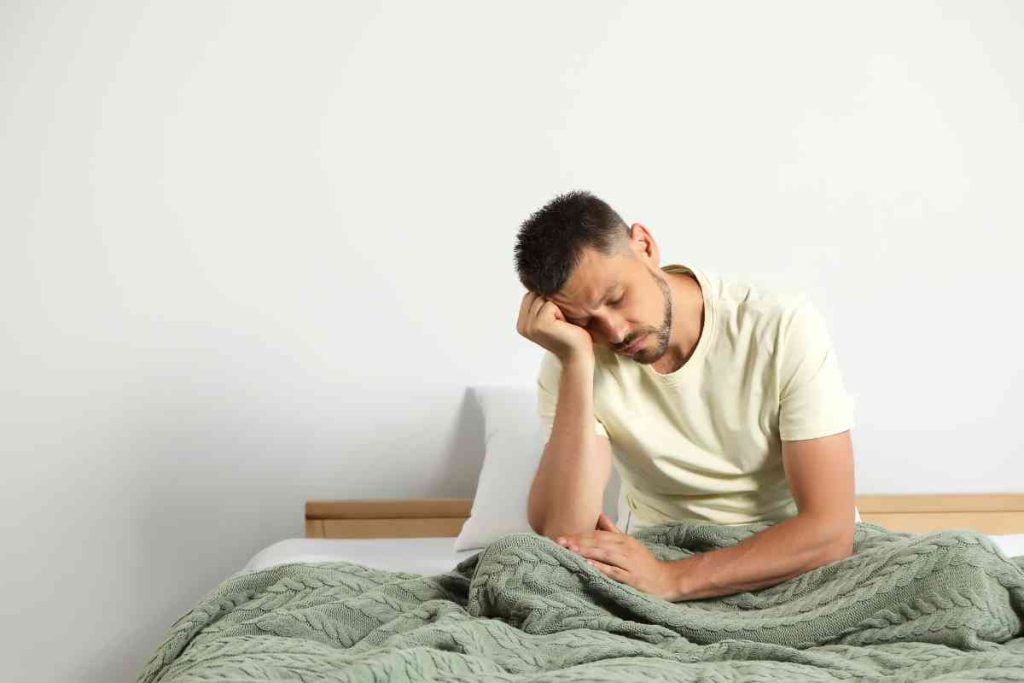
Sleep deprivation can arise from deliberate lifestyle choices and attempting to work harder and attain certain goals within specified period of time, or it can be as a result of sleep disorder.
Lifestyle choices include things like habitual consumption of Central nervous system stimulants such as Caffeine, deliberately staying awake to pray at certain hours of the night, use of electronic devices/internet activities late in the night, and habitually using alarm clock to wake someone up with the aim achieving some tasks.
Some drugs could also have sleep deprivation as the side effect. High stress level, work pattern such as shift work, alcohol use, cigarette smoking, and sleeping in a new environment such as hotel can all lead to sleep deprivation.6
Certain ill-health such as Common cold, chronic pain, uncontrolled diabetes mellitus also could lead to sleep deprivation. Degenerative brain disorders such as Alzheimer’s disease or Parkinson’s disease cause sleep deprivation.
Some other mental health issues such as depression, mania, anxiety state, post-traumatic stress disorder (PSTD), and somniphobia (fear of sleep); all cause sleep deprivation.6 Noisy environment also significantly, adversely affects sleep.
It has been documented that presence of children in a family contributes to inadequate sleep among adults in that family,7 probably as a result of penchant for noise making.
Symptoms Of Sleep Deprivation
Some common symptoms of sleep deprivation are;1,6
- Frequent yawning
- Fatigue
- Excessive sleepiness during the day
- Irritability
- Headaches
- Difficulty with thinking and remembering
Some severe symptoms include;6
- Drooping eyelids
- Impulsive and reckless behaviours
- Impaired judgement
- Hand tremors
- Visual and tactile hallucinations
Effects Of Sleep Deprivation
Insufficient sleep affects different organs and systems of the body, and results in different health challenges. Some of the effects are as follows;
- Central Nervous System: Insufficient sleep leads to exhaustion of the brain, making it to function sub-optimally. This could manifest as poor concentration, difficulty in learning, poor coordination, etc.1
- Mental Health: Long duration of insufficient sleep could lead to mental health problems such as depression, hallucinations, paranoia, anxiety state, mood swings, etc. 1
- Cardiovascular System: In a study conducted in 2018, it was found that persons who do not get sufficient sleep over some period of time, have 29% higher chance of developing Cardiovascular Diseases.8
- Respiratory System: Prolonged period of insufficient is occasionally associated with Obstructive Sleep Apnoea Syndrome (OSAS).9
- Immune System: Some studies have shown that insufficient sleep increases the risk of infection, and also increases the chances of poor outcome of infections.10,11 In a study conducted in Taiwan, and published in 2016, it was found that patients with sleep deprivation showed a 1.23-fold greater risk of being infected with herpes zoster.12
- Endocrine System: Insulin resistance that eventually manifests as diabetes mellitus, has been shown to be associated with chronic insufficient sleep.13
- Digestive System: Some studies found strong association between sleep deprivation and some gastrointestinal tract diseases.14-17 Some of these diseases are; peptic ulcer disease, gastroesophageal reflux disease (GERD), and irritable bowel syndrome (IBS)
- Cancers: Some studies have found out that insufficient sleep is a risk factor for impaired anti-tumour response, hence this has been associated with the risk of some cancers such as prostate, breast, and colorectal.18-21
Prevention Of Sleep Deprivation
To prevent the effects of sleep deprivation, it is important that one makes deliberate efforts to get at least seven hours of sleep every night. The other definite steps one can take to prevent sleep deprivation include;1
- Avoidance of ingestion of Caffeine after 12 noon
- Deliberately sticking to definite bedtime schedule for both going to bed, and waking up
- Regular exercises, but not close to bedtime in the evening
- Avoidance of heavy meal, close to bedtime
- Reduction of alcohol intake
- Avoidance of cigarette smoking
- Not using electronic gadget close to bedtime
- Making efforts to perform relaxation activities such as reading novels, about an hour before the usual scheduled bedtime.
REFERENCES
- https://www.healthline.com/health/sleep-deprivation/effects-on-body (Accessed, 16/12/2023)
- World Health Organization. WHO technical meeting on sleep and health. Bonn, Germany, 22 – 24 January 2004.
- Sateia MJ. International classification of sleep disorders-third edition: highlights and modifications. Chest. 2014 Nov;146(5):1387-1394. doi: 10.1378/chest.14-0970. PMID: 25367475. https://pubmed.ncbi.nlm.nih.gov/25367475/#:~:text=The%20ICSD%2D3%20is%20built,parasomnias%2C%20and%20other%20sleep%20disorders. (Accessed, 16/12/2023)
- Hafner, M.; Stepanek, M.; Taylor, J.; Troxel, W.M.; van Stolk, C. Why Sleep Matters—The Economic Costs of Insufficient Sleep: A Comparative Cross-Country Analysis; RAND Corporation: Santa Monica, CA, USA, 2016.
- Cirelli, C.; Benca, R.; Eichler, A.F. Insufficient Sleep: Definition, Epidemiology, and Adverse Outcomes. 2017.
- https://my.clevelandclinic.org/health/diseases/23970-sleep-deprivation
- Chapman, D.P.; Wheaton, A.G.; Perry, G.S.; Sturgis, S.L.; Strine, T.W.; Croft, J.B. Household demographics and perceived insufficient sleep among US adults. J. Community Health 2012, 37, 344–349.
- Bertisch SM, Pollock BD, Mittleman MA, Buysse, DJ, Bazzano LA, Gottlieb DJ, Redline S. Insomnia with objective short sleep duration and risk of incident cardiovascular disease and all-cause mortality: Sleep Heart Health Study. Sleep 2018, 41, zsy047.
- Kim J, Hakim F, Kheirandish-Gozal L, Gozal D. Inflammatory pathways in children with insufficient or disordered sleep. Respir. Physiol. Neurobiol. 2011, 178, 465–474.
- Prather, A. A., Janicki-Deverts, D., Hall, M. H. & Cohen, S. Behaviorally assessed sleep and susceptibility to the common cold. Sleep 38, 1353–1359 (2015).
- Fernandes, E. R. et al. Sleep disturbance during infection compromises Tfh differentiation and impacts host immunity. iScience 23, 101599 (2020).
- Chung, W. S., Lin, H. H. & Cheng, N. C. The incidence and risk of herpes zoster in patients with sleep disorders: a population-based cohort study. Medicine (Baltimore) 95, e2195 (2016).
- Dutil, C.; Chaput, J.P. Inadequate sleep as a contributor to type 2 diabetes in children and adolescents. Nutr. Diabetes 2017, 7, e266.
- Ali T, Choe J, Awab A, Wagener TL, Orr WC. Sleep, immunity and inflammation in gastrointestinal disorders. World J Gastroenterol. 2013;19(48):9231–9239
- Ranjbaran Z, Keefer L, Farhadi A, Stepanski E, Sedghi S, Keshavarzian A. Impact of sleep disturbances in inflammatory bowel disease. J Gastroenterol Hepatol. 2007;22(11):1748–1753.
- Chen MJ, Wu MS, Lin JT, et al. Gastroesophageal reflux disease and sleep quality in a Chinese population. J Formos Med Assoc. 2009;108(1):53–60
- Ananthakrishnan AN, Long MD, Martin CF, Sandler RS, Kappelman MD. Sleep disturbance and risk of active disease in patients with Crohn’s disease and ulcerative colitis. Clin Gastroenterol Hepatol. 2013;11(8):965–971
- Kakizaki, M. et al. Sleep duration and the risk of breast cancer: the Ohsaki Cohort Study. Br. J. Cancer 99, 2008;1502–1505
- Kakizaki, M. et al. Sleep duration and the risk of prostate cancer: the Ohsaki Cohort Study. Br. J. Cancer 99, 2008;176–178
- Jiao, L. et al. Sleep duration and incidence of colorectal cancer in postmenopausal women. Br. J. Cancer 108, 2013; 213–221
- Cao, J. et al. Sleep duration and risk of breast cancer: The JACC Study. Breast Cancer Res. Treat. 174, 2019; 219–225


